The Unmoved Sage: Embracing Life's Flow
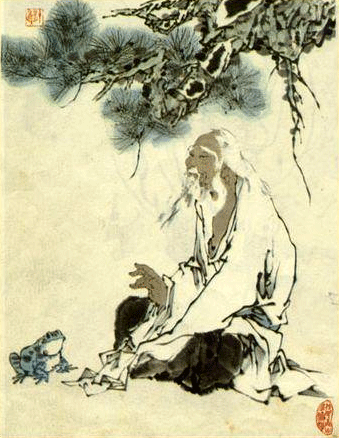
Chuang Tzu's assertion that "the sage moves with the world and is unaffected by it" invites us to contemplate the delicate balance between engagement and detachment. In a world rife with chaos and uncertainty, this wisdom speaks to the heart of our spiritual journey, urging us to navigate life's currents without being swept away by them. The sage embodies a profound understanding of existence, suggesting that true wisdom lies not in isolation from the world but in a harmonious relationship with it.
This quote challenges us to reconsider our responses to external circumstances. In a society that often equates success with emotional investment in outcomes, Chuang Tzu's perspective offers a refreshing alternative. It encourages us to cultivate a sense of inner peace and resilience, allowing us to engage with life fully while remaining anchored in our true selves. This duality of engagement and detachment is not merely a philosophical concept; it is a practical guide for living with grace amidst the inevitable fluctuations of life.
The image / the metaphor
At the heart of Chuang Tzu's quote lies a vivid metaphor: the sage as a figure who moves fluidly through the world, akin to water flowing around obstacles. The imagery evokes a sense of grace and adaptability, suggesting that the sage does not resist the currents of life but instead flows with them. The choice of the verb "moves" implies an active participation in the world, while "unaffected" conveys a profound inner stability. This juxtaposition creates a powerful image of a being who is both engaged and serene, embodying the essence of Taoist wisdom.
Diving deeper into this metaphor, we can see that the sage's detachment is not one of indifference but rather a conscious choice to remain centered amidst external turmoil. This detachment allows for a clearer perception of reality, free from the distortions of fear, desire, or attachment. The sage, therefore, becomes a mirror reflecting the world without being marred by it, embodying the Taoist principle of wu wei, or effortless action. In this way, the sage teaches us that true engagement with life arises from a place of profound inner peace.
In the speaker's tradition
Chuang Tzu's teachings are deeply rooted in the Taoist tradition, which emphasizes harmony with the Tao, or the fundamental nature of the universe. This concept resonates with ideas such as dharma in Buddhism, which refers to the natural order of things, and kenosis in Christian mysticism, which speaks to the self-emptying of the divine. The sage's ability to move with the world while remaining unaffected mirrors the Taoist ideal of aligning oneself with the natural flow of existence, transcending the dualities of attachment and aversion.
In the text of the Zhuangzi, we find numerous anecdotes that illustrate the sage's wisdom and detachment. One such story involves a great fish that transforms into a bird, symbolizing the fluidity of existence and the importance of adapting to change. This narrative reinforces the idea that the sage, like the fish, navigates the waters of life with ease, embodying the principle of sunyata, or emptiness, which allows for a deeper understanding of the interconnectedness of all things. Through these teachings, Chuang Tzu invites us to embrace the world while remaining anchored in our essence.
Living the teaching
Consider a modern scenario where this teaching can be applied: a workplace filled with stress and competition. In such an environment, one might feel pressured to conform to the frantic pace and emotional turbulence of colleagues. However, by embodying the wisdom of the sage, an individual can choose to engage with their work while maintaining a sense of inner calm. This approach not only enhances personal well-being but also positively influences the atmosphere around them, demonstrating that one can be a source of stability amidst chaos.
Another application of this teaching can be found in personal relationships, particularly during conflicts. When faced with disagreements, it is easy to become entangled in emotional reactions and defensiveness. By practicing the sage's detachment, one can approach the situation with a clear mind and an open heart, allowing for constructive dialogue rather than escalating tensions. This mindful engagement fosters deeper connections and understanding, illustrating how the sage's wisdom can transform our interactions and enrich our lives.
A reflection
As we reflect on Chuang Tzu's profound insight, we are invited to ponder: How can I cultivate a sense of inner peace that allows me to engage with the world without being overwhelmed by it? This question encourages us to explore our own relationship with the external circumstances of our lives, inviting us to seek the balance between participation and detachment. In this contemplation, we may discover pathways to embody the sage's wisdom, ultimately leading us to a more harmonious existence.



Join the BrightStar Community
Stay connected with daily inspiration, event announcements, and community wisdom